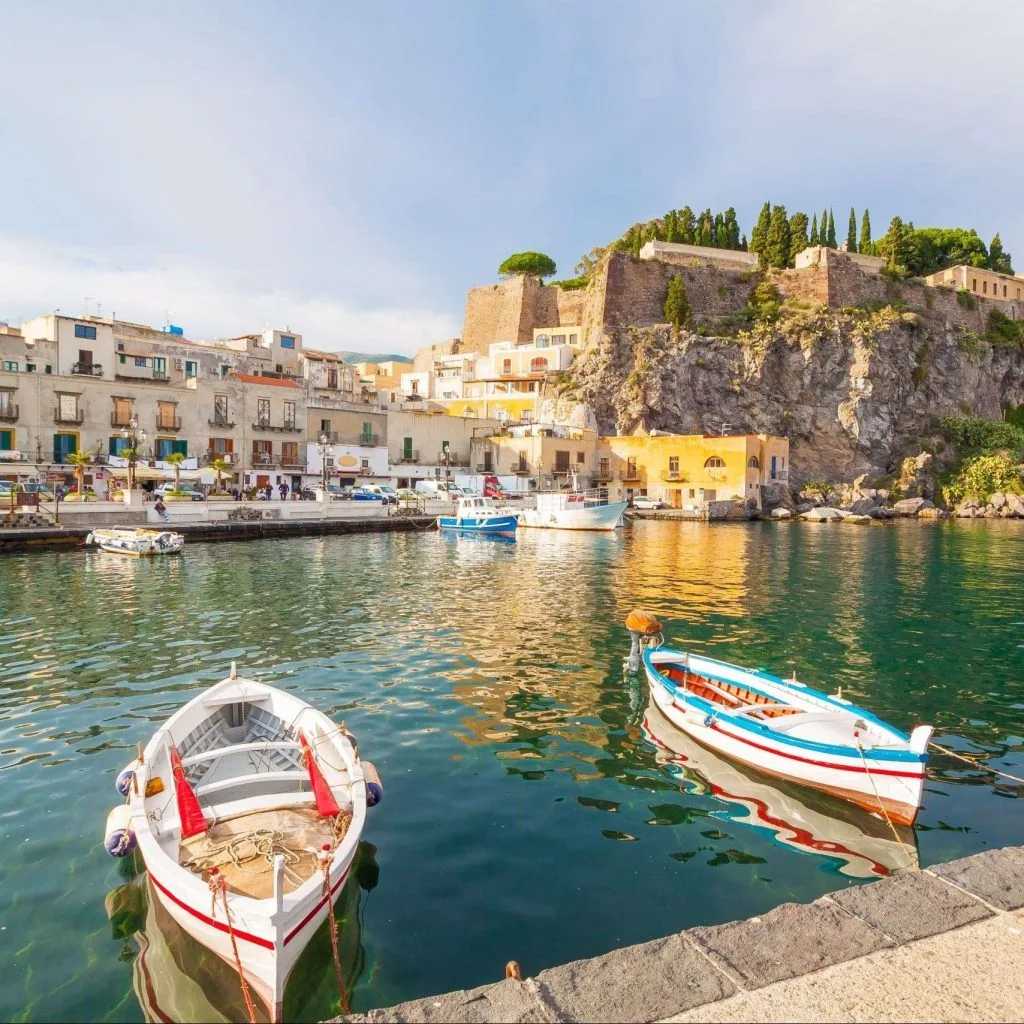
Cosa vedere a Lipari
Il Castello, i musei, le chiese e i borghi: i luoghi imperdibili dell'isola di Lipari.
Tra storia millenaria, chiese, musei e panorami mozzafiato, ecco i luoghi da non perdere durante una visita all'isola di Lipari.
Castello di Lipari
Questa imponente struttura si erge a 50 metri d'altezza, a strapiombo sul mare. La cinta muraria attuale risale al 1500 ed è stata edificata per volere di Carlo V. L'edificio si presenta in diversi stili architettonici: dal tardo-romano al neogotico, fino al barocco di epoca borbonica. L'area in cui sorge il castello è di origine antichissima: sono stati rinvenuti reperti che risalgono fino al 5.000 a.C., oggi custoditi nel Museo Archeologico Eoliano «Bernabò Brea», ospitato proprio all'interno di questo edificio.
Marina Corta
Se volete trascorrere una serata tranquilla e romantica, vi consigliamo Marina Corta. È il vero fulcro storico dell'isola, costituito da un intricato sistema di vicoli e viuzze contornati da splendidi edifici dalla tipica architettura eoliana. Qui sorgono la Cattedrale di San Bartolomeo e il Chiostro Normanno, che faceva parte di un antico monastero benedettino. Marina Corta è inoltre la località più vibrante delle Eolie, dove la sera si concentrano i principali eventi dell'arcipelago.
Museo Archeologico Eoliano
Nato nel 1954, espone organicamente i risultati degli scavi condotti sulle Isole Eolie dagli anni '40 ad oggi. È un museo «vivo», in costante aggiornamento e in rapporto continuo con il territorio di riferimento. La struttura, all'interno del Castello di Lipari, è suddivisa in sei aree differenti, dalla sezione preistorica a quella di paleontologia. Nella prima sezione si trovano tracce e reperti appartenenti al neolitico.
Cattedrale di San Bartolomeo
È sempre stata, nel corso dei secoli, il centro pulsante della vita eoliana, tanto da guadagnarsi l'appellativo di «La città». Costruita a partire dal 1080 dai normanni, ha subito diverse ristrutturazioni e modifiche, assimilando stili greco e normanno, con un intervento importante nel 1861 dopo il crollo della volta e del timpano della facciata. La facciata stupisce per la sua maestosità, mentre la scalinata su cui sorge le regala uno slancio, in una sorta di simbolico allungo verso il cielo.
Osservatorio geofisico
Sorge sul monte Guardia. Dal piccolo piazzale potrete godere di una vista unica sull'isola di Vulcano e ammirare la scogliera che cade a picco sul mare, oltre al profilo in lontananza di Filicudi e Alicudi.
Chiesa della Madonna della Catena
È un'altra delle chiese più importanti di Lipari, risalente al XVI secolo. La piccola chiesa è caratterizzata da uno stile dorico, anche se negli anni non sono mancate ristrutturazioni e contaminazioni. Il luogo, complice il paesaggio, regala un angolo di pace, relax e soprattutto silenzio, che ben dispone a un momento di raccoglimento e di preghiera.
Chiostro Normanno
Il Chiostro Normanno è parte del monastero benedettino, il primo costruito in Sicilia nel XII secolo, distrutto durante l'invasione turca del 1544. In origine era stato edificato con la chiesa secondo i dettami benedettini, con il chiostro rivolto a sud e la chiesa a nord. Negli anni perse il suo ruolo centrale: fu prima riconvertito in cimitero e poi coperto da un grosso muro, dopo un terremoto.
Chiesa di San Giuseppe
La prima cosa che colpisce è la sua posizione a ridosso del mare. La chiesa di San Giuseppe fu edificata sopra una cripta che, secondo una leggenda, custodiva le reliquie di San Bartolomeo. Si trova vicino al piccolo porto di Marina Corta, in una posizione facilmente raggiungibile, ed è possibile visitarla fino a tarda sera.
Belvedere Quattrocchi
A soli quattro chilometri dal centro storico troverete il luogo più famoso dell'isola: il Belvedere Quattrocchi, il punto panoramico più spettacolare di Lipari. Raggiungibile comodamente anche in auto, regala una splendida vista sul versante meridionale dell'isola. A fare da contorno, una natura rigogliosa ricca di agavi, fichi d'india e vegetazione tipicamente mediterranea.
Cave di Pomice
Proseguendo lungo il versante settentrionale ci si imbatte nelle vecchie Cave di Pomice. L'estrazione di questa pietra ha origine negli anni '60 del secolo scorso, mentre l'ossidiana veniva estratta già in tempi preistorici. Oggi le cave sono completamente in disuso, ma in questa zona sorgono baie e spiagge dalla bellezza disarmante: luoghi idilliaci in cui fare indimenticabili bagni.
Between thousand-year history, churches, museums and breathtaking views, here are the places not to miss on a visit to the island of Lipari.
Castle of Lipari
This imposing structure rises 50 metres high, sheer above the sea. The present-day walls date back to the 1500s and were built at the behest of Charles V. The building displays several architectural styles: from late Roman to neo-Gothic and on to the Baroque of the Bourbon era. The area on which the castle stands is of very ancient origin: finds dating as far back as 5,000 BC have been unearthed, today kept in the “Bernabò Brea” Aeolian Archaeological Museum, housed within this very building.
Marina Corta
If you want to spend a quiet, romantic evening, we recommend Marina Corta. It is the true historic heart of the island, made up of an intricate network of alleys and lanes lined with beautiful buildings of typical Aeolian architecture. Here stand the Cathedral of San Bartolomeo and the Norman Cloister, once part of an ancient Benedictine monastery. Marina Corta is also the liveliest spot in the whole of the Aeolian Islands, where the archipelago's main events gather in the evening.
Aeolian Archaeological Museum
Founded in 1954, it presents in an organised way the results of the excavations carried out on the Aeolian Islands from the 1940s to the present day. It is a “living” museum, constantly updated and in continuous dialogue with its territory. Housed within the Castle of Lipari, it is divided into six different sections, from prehistory to palaeontology. In the first section you will find traces and finds from the Neolithic period.
Cathedral of San Bartolomeo
Over the centuries it has always been the beating heart of Aeolian life, so much so that it earned the nickname “the city”. Begun in 1080 by the Normans, it has undergone several renovations and changes, absorbing Greek and Norman styles, with a major intervention in 1861 after the collapse of the vault and the pediment of the façade. The façade will surely astonish you with its grandeur, while the staircase on which the building stands gives it an upward thrust, a kind of symbolic reach towards the sky.
Geophysical Observatory
It stands on Monte Guardia. From the small terrace you can enjoy a unique view of the island of Vulcano and admire the cliff that plunges sheer into the sea, as well as the distant outline of Filicudi and Alicudi.
Church of the Madonna della Catena
It is another of the most important churches in Lipari, dating from the 16th century. The small church is marked by a Doric style, though over the years renovations and influences have not been lacking. The place, helped by the surrounding landscape, offers a corner of peace, relaxation and above all silence, well suited to a moment of contemplation and prayer.
Norman Cloister
The Norman Cloister is part of the Benedictine monastery, the first built in Sicily, in the 12th century, and destroyed during the Turkish invasion of 1544. Originally it was built together with the church according to Benedictine principles, with the cloister facing south and the church to the north. Over the years it lost its central role: it was first converted into a cemetery and then covered by a large wall after an earthquake.
Church of San Giuseppe
The first thing that strikes you is its position right by the sea. The church of San Giuseppe was built above a crypt which, according to legend, held the relics of San Bartolomeo. It lies near the small harbour of Marina Corta, in an easily reachable position, and can be visited until late in the evening.
Quattrocchi Belvedere
Just four kilometres from the old town you will find the island's most famous spot: the Quattrocchi Belvedere, the most spectacular viewpoint in Lipari. Easily reachable by car, it offers a splendid view over the southern side of the island. The setting is completed by lush nature rich in agaves, prickly pears and typically Mediterranean vegetation.
Pumice Quarries
Continuing along the northern side, you come across the old Pumice Quarries. The extraction of this stone began in the 1960s, whereas obsidian was already being mined in prehistoric times. Today the quarries are completely disused, but in this area there are bays and beaches of disarming beauty: idyllic places for unforgettable swims.
Entre histoire millénaire, églises, musées et panoramas à couper le souffle, voici les lieux à ne pas manquer lors d'une visite de l'île de Lipari.
Château de Lipari
Cette imposante structure s'élève à 50 mètres de hauteur, à pic au-dessus de la mer. L'enceinte actuelle remonte au XVIe siècle et fut édifiée sur ordre de Charles Quint. L'édifice présente plusieurs styles architecturaux : du tardo-romain au néogothique, jusqu'au baroque d'époque bourbonienne. La zone sur laquelle s'élève le château est d'origine très ancienne : on y a découvert des vestiges remontant jusqu'à 5 000 av. J.-C., aujourd'hui conservés au Musée archéologique éolien « Bernabò Brea », abrité dans ce même édifice.
Marina Corta
Si vous souhaitez passer une soirée tranquille et romantique, nous vous conseillons Marina Corta. C'est le véritable cœur historique de l'île, constitué d'un dédale de ruelles bordées de magnifiques édifices de l'architecture éolienne typique. Ici se dressent la cathédrale de San Bartolomeo et le Cloître normand, qui faisait partie d'un ancien monastère bénédictin. Marina Corta est aussi le lieu le plus animé de toutes les Éoliennes, où se concentrent le soir les principaux événements de l'archipel.
Musée archéologique éolien
Né en 1954, il présente de manière organisée les résultats des fouilles menées sur les Îles Éoliennes des années 1940 à aujourd'hui. C'est un musée « vivant », en constante mise à jour et en dialogue continu avec son territoire. Installé dans le Château de Lipari, il est divisé en six sections différentes, de la préhistoire à la paléontologie. Dans la première section se trouvent des traces et des vestiges appartenant au néolithique.
Cathédrale de San Bartolomeo
Au fil des siècles, elle a toujours été le cœur battant de la vie éolienne, au point de mériter le surnom de « la cité ». Construite à partir de 1080 par les Normands, elle a connu plusieurs restaurations et modifications, assimilant les styles grec et normand, avec une intervention importante en 1861 après l'effondrement de la voûte et du tympan de la façade. La façade vous étonnera par sa majesté, tandis que l'escalier sur lequel l'édifice s'élève lui confère un élan, une sorte de symbolique poussée vers le ciel.
Observatoire géophysique
Il se dresse sur le mont Guardia. Depuis la petite esplanade, vous pourrez profiter d'une vue unique sur l'île de Vulcano et admirer la falaise qui tombe à pic dans la mer, ainsi que le profil lointain de Filicudi et Alicudi.
Église de la Madonna della Catena
C'est une autre des églises les plus importantes de Lipari, datant du XVIe siècle. La petite église se caractérise par un style dorique, même si, au fil des ans, les restaurations et les influences n'ont pas manqué. Le lieu, favorisé par le paysage, offre un coin de paix, de détente et surtout de silence, propice au recueillement et à la prière.
Cloître normand
Le Cloître normand fait partie du monastère bénédictin, le premier construit en Sicile, au XIIe siècle, détruit lors de l'invasion turque de 1544. À l'origine, il avait été édifié avec l'église selon les préceptes bénédictins, le cloître orienté au sud et l'église au nord. Au fil des ans, il perdit son rôle central : il fut d'abord reconverti en cimetière, puis recouvert d'un grand mur, après un tremblement de terre.
Église de San Giuseppe
La première chose qui frappe, c'est sa position au bord de la mer. L'église de San Giuseppe fut édifiée au-dessus d'une crypte qui, selon une légende, conservait les reliques de San Bartolomeo. Elle se trouve près du petit port de Marina Corta, dans un emplacement facilement accessible, et peut être visitée jusque tard le soir.
Belvédère Quattrocchi
À seulement quatre kilomètres du centre historique, vous trouverez le lieu le plus célèbre de l'île : le Belvédère Quattrocchi, le point panoramique le plus spectaculaire de Lipari. Facilement accessible en voiture, il offre une vue splendide sur le versant méridional de l'île. Le tout est encadré d'une nature luxuriante, riche en agaves, figuiers de Barbarie et végétation typiquement méditerranéenne.
Carrières de pierre ponce
En poursuivant le long du versant septentrional, on tombe sur les anciennes carrières de pierre ponce. L'extraction de cette pierre remonte aux années 1960, tandis que l'obsidienne était déjà extraite à l'époque préhistorique. Aujourd'hui, les carrières sont totalement désaffectées, mais cette zone abrite des baies et des plages d'une beauté désarmante : des lieux idylliques pour des baignades inoubliables.
Zwischen jahrtausendealter Geschichte, Kirchen, Museen und atemberaubenden Ausblicken — hier sind die Orte, die man bei einem Besuch der Insel Lipari nicht verpassen sollte.
Burg von Lipari
Dieses imposante Bauwerk erhebt sich 50 Meter hoch, steil über dem Meer. Die heutige Befestigungsmauer stammt aus dem 16. Jahrhundert und wurde im Auftrag Karls V. errichtet. Das Gebäude zeigt verschiedene Baustile: vom Spätrömischen über die Neogotik bis zum Barock der Bourbonenzeit. Das Areal, auf dem die Burg steht, ist sehr alten Ursprungs: Man hat Funde entdeckt, die bis 5.000 v. Chr. zurückreichen und heute im Äolischen Archäologischen Museum „Bernabò Brea“ aufbewahrt werden, das sich in eben diesem Gebäude befindet.
Marina Corta
Wenn Sie einen ruhigen, romantischen Abend verbringen möchten, empfehlen wir Marina Corta. Es ist das eigentliche historische Herz der Insel, gebildet aus einem verwinkelten System von Gassen, gesäumt von prächtigen Gebäuden der typischen äolischen Architektur. Hier stehen die Kathedrale San Bartolomeo und der Normannische Kreuzgang, der zu einem alten Benediktinerkloster gehörte. Marina Corta ist zudem der lebendigste Ort der gesamten Äolischen Inseln, wo sich am Abend die wichtigsten Veranstaltungen des Archipels konzentrieren.
Äolisches Archäologisches Museum
1954 gegründet, präsentiert es geordnet die Ergebnisse der Ausgrabungen, die seit den 1940er-Jahren bis heute auf den Äolischen Inseln durchgeführt wurden. Es ist ein „lebendiges“ Museum, ständig aktualisiert und in fortwährendem Austausch mit seinem Bezugsgebiet. Innerhalb der Burg von Lipari untergebracht, ist es in sechs verschiedene Bereiche gegliedert, von der Vorgeschichte bis zur Paläontologie. Im ersten Bereich finden sich Spuren und Funde aus der Jungsteinzeit.
Kathedrale San Bartolomeo
Im Laufe der Jahrhunderte war sie stets das pulsierende Herz des äolischen Lebens, sodass sie den Beinamen „die Stadt“ erhielt. Ab 1080 von den Normannen erbaut, erfuhr sie mehrere Umbauten und Veränderungen und vereinte griechische und normannische Stile, mit einem bedeutenden Eingriff im Jahr 1861 nach dem Einsturz des Gewölbes und des Giebels der Fassade. Die Fassade wird Sie mit ihrer Erhabenheit überraschen, während die Treppe, auf der das Gebäude steht, ihm einen Aufschwung verleiht — eine Art symbolisches Streben zum Himmel.
Geophysikalisches Observatorium
Es erhebt sich auf dem Monte Guardia. Vom kleinen Platz aus genießen Sie einen einzigartigen Blick auf die Insel Vulcano und bewundern die Klippe, die senkrecht ins Meer abfällt, sowie das ferne Profil von Filicudi und Alicudi.
Kirche der Madonna della Catena
Sie ist eine weitere der bedeutendsten Kirchen Liparis und stammt aus dem 16. Jahrhundert. Die kleine Kirche zeichnet sich durch einen dorischen Stil aus, auch wenn es über die Jahre an Umbauten und Einflüssen nicht gefehlt hat. Der Ort schenkt, auch dank der Landschaft, einen Winkel des Friedens, der Entspannung und vor allem der Stille, der zu einem Moment der Einkehr und des Gebets einlädt.
Normannischer Kreuzgang
Der Normannische Kreuzgang ist Teil des Benediktinerklosters, des ersten in Sizilien errichteten, aus dem 12. Jahrhundert, das während der türkischen Invasion von 1544 zerstört wurde. Ursprünglich war er zusammen mit der Kirche nach benediktinischen Vorgaben erbaut worden, der Kreuzgang nach Süden, die Kirche nach Norden ausgerichtet. Im Laufe der Jahre verlor er seine zentrale Rolle: Zunächst wurde er in einen Friedhof umgewandelt und dann nach einem Erdbeben von einer großen Mauer bedeckt.
Kirche San Giuseppe
Das Erste, was auffällt, ist ihre Lage unmittelbar am Meer. Die Kirche San Giuseppe wurde über einer Krypta errichtet, die der Legende nach die Reliquien des heiligen Bartholomäus bewahrte. Sie liegt nahe dem kleinen Hafen von Marina Corta, in leicht erreichbarer Lage, und kann bis spät am Abend besichtigt werden.
Belvedere Quattrocchi
Nur vier Kilometer vom historischen Zentrum entfernt finden Sie den berühmtesten Ort der Insel: das Belvedere Quattrocchi, den spektakulärsten Aussichtspunkt von Lipari. Bequem auch mit dem Auto erreichbar, bietet es einen herrlichen Blick auf die Südseite der Insel. Den Rahmen bildet eine üppige Natur, reich an Agaven, Feigenkakteen und typisch mediterraner Vegetation.
Bimsstein-Steinbrüche
Weiter entlang der Nordseite stößt man auf die alten Bimsstein-Steinbrüche. Der Abbau dieses Steins begann in den 1960er-Jahren, während Obsidian bereits in prähistorischer Zeit gewonnen wurde. Heute sind die Steinbrüche völlig stillgelegt, doch in diesem Gebiet liegen Buchten und Strände von entwaffnender Schönheit: idyllische Orte für unvergessliche Bademomente.